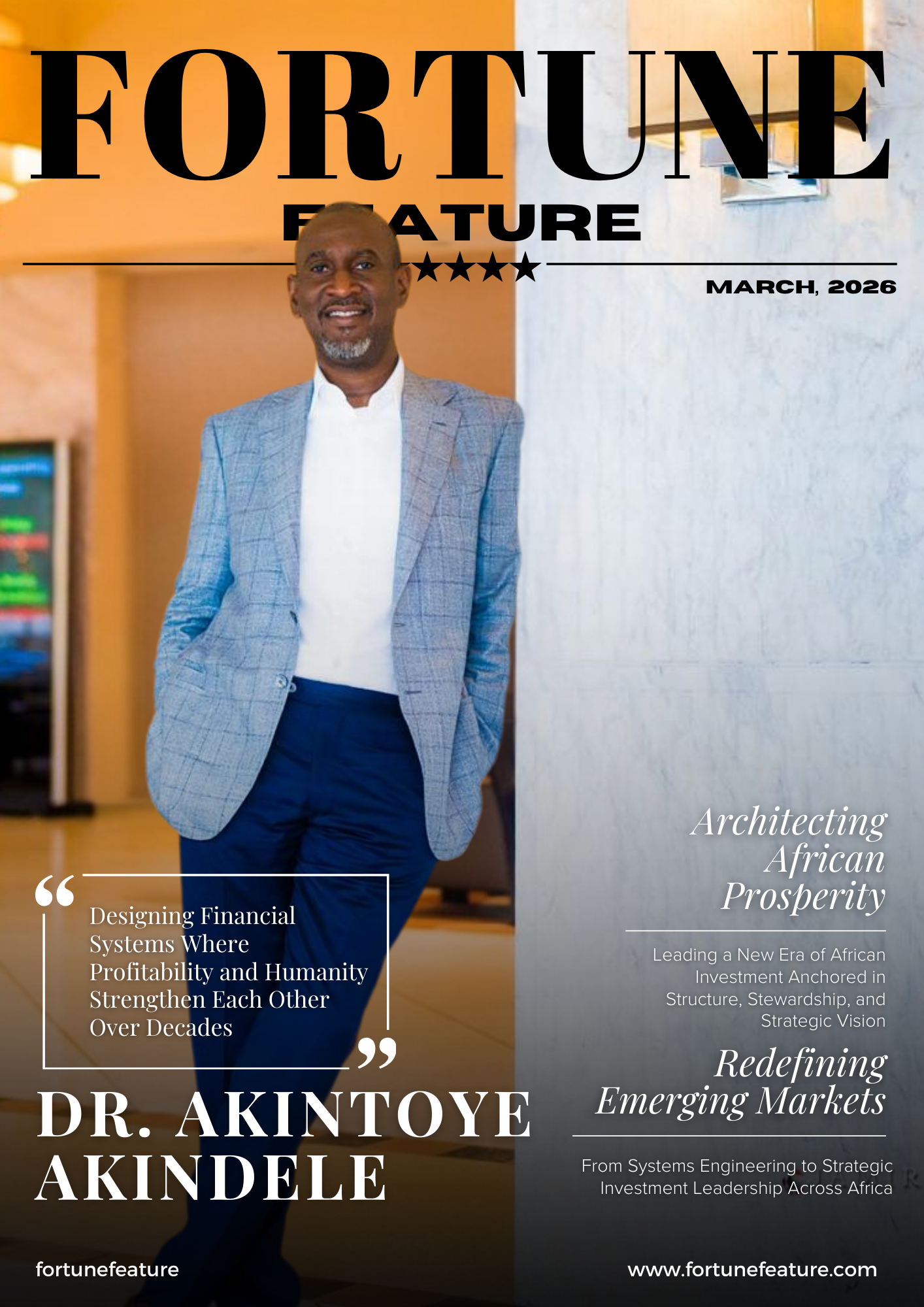
In a world where capital frequently moves faster than consequence, where liquidity events are celebrated more loudly than long-term outcomes, a quieter revolution is unfolding—one rooted in patience, structure, and responsibility. At the center of that evolution stands Dr. Akintoye Akindele, CFA, DBA, FICA: investor, technologist, institutional architect, and founder of Platform Capital.
His work represents more than portfolio construction. It represents a disciplined rethinking of how capital should behave in emerging markets—and, more specifically, in Africa’s rapidly transforming economic landscape.
For Dr. Akindele, finance is not simply about allocation. It is about architecture.
A Systems Mindset Forged in Engineering
Long before he entered boardrooms or structured private equity transactions, Dr. Akindele was trained to think like an engineer. Graduating with honors in Chemical Engineering from Obafemi Awolowo University in the mid-1990s, he developed a foundational understanding of systems design.
Engineering is the science of relationships—how components interact, how stress propagates, how systems fail, and how resilience is built into structure. It teaches that integrity is not accidental. It is designed.
Those early lessons would later define his philosophy of capital.
As he observed Africa’s development trajectory, he noticed a recurring pattern: the continent was rich in resources but often structurally constrained. Raw materials were exported. Finished goods were imported. Value chains were incomplete. Institutional systems lacked depth.
The problem was not potential. It was architecture.
Expanding the Toolkit: Technology and Finance
Rather than narrowing his focus, Dr. Akindele expanded it.
He pursued certifications in Microsoft systems, Cisco networking, and database management at a time when digital transformation was not yet mainstream discourse. He recognized early that technology would become a foundational lever for economic acceleration across emerging markets.
Simultaneously, he deepened his financial expertise. Earning the CFA charter anchored him in global standards of investment analysis and portfolio management. Completing a Doctorate in Business Administration further strengthened his strategic and theoretical grounding.
Engineering taught him structure.
Technology taught him scalability.
Finance taught him allocation.
Together, they formed a triad of disciplines uniquely suited to institutional development.
The Structural Misalignment of Capital in Africa

As his career advanced through banking and investment roles, Dr. Akindele identified a structural misalignment in Africa’s capital ecosystem. Much of the capital entering the continent operated under compressed time horizons—typically five to seven years—optimized for exits rather than endurance.
While such models can perform efficiently in mature markets with stable infrastructure, they often struggle in environments where institutions are still being built.
Healthcare networks require long-term capital.
Educational ecosystems compound over decades.
Energy infrastructure matures slowly but delivers sustained impact.
Short-term exit pressure can distort strategic decisions, leading to fragile growth rather than resilient expansion.
Dr. Akindele’s response was not ideological opposition to existing models, but structural redesign. Africa, he believed, requires patient capital—capital capable of compounding over longer horizons without sacrificing discipline.
Patience, in this context, is not delay. It is durability.
Platform Capital: Freedom Anchored in Values
Platform Capital was established as an embodiment of this philosophy. Unlike traditional firms constrained by narrow sector mandates or rigid stage definitions, it operates as stage-agnostic, sector-agnostic, size-agnostic, and region-agnostic.
This flexibility allows the firm to invest in opportunities wherever structural necessity aligns with scalable potential.
Yet freedom without anchor can lead to fragmentation. To prevent this, Platform Capital operates under a core value framework summarized by the acronym BLACK:
Being your brother’s keeper
Loyalty
Authenticity
Capacity
Knowledge
These principles are not symbolic. They guide partner selection, governance expectations, and long-term alignment strategies. Being your brother’s keeper reinforces stakeholder responsibility. Loyalty fosters trust during volatility. Authenticity enhances transparency. Capacity ensures execution strength. Knowledge drives informed decision-making.
Values, in this model, are operational assets.
Conviction as Institutional Strategy
One of Dr. Akindele’s defining characteristics is conviction. In financial markets shaped by trend cycles and momentum flows, conviction provides strategic independence.
Rather than chasing visibility, Platform Capital evaluates structural necessity. The firm prioritizes foundational sectors—healthcare, education, sustainable energy, infrastructure—where demand is systemic rather than cyclical.
Conviction requires rigorous analysis. It also requires courage.
Investing ahead of consensus often means entering sectors before they become fashionable. It means supporting founders whose visions may not yet align with prevailing narratives.
But when conviction is disciplined by data and governance, it becomes a competitive advantage.
Measuring Success in Dual Dimensions

Perhaps the most profound departure in Dr. Akindele’s philosophy lies in how he defines success.
Financial performance is essential. Without returns, capital cannot recycle and scale. Yet he insists that profit alone is incomplete.
To him, success is measured in dual dimensions: value created and lives improved.
Platform Capital’s initiatives have directly touched approximately 1.2 million lives through investments spanning healthcare access, educational expansion, job creation, and community empowerment.
These figures are not abstract. They represent tangible improvements in access, dignity, and opportunity.
Capital, when aligned with humanity, compounds trust.
Financing Sustainability Through Innovation
Looking forward, Dr. Akindele is pioneering innovative financing mechanisms that integrate environmental and social value into structured investment models.
One of the most promising developments involves combining carbon credits with social impact credits into dual-revenue frameworks.
Carbon credits monetize emissions reductions. Social impact credits quantify measurable community benefits—improved health outcomes, employment gains, and environmental restoration.
Consider a renewable energy initiative. Reduced emissions generate carbon credits. Increased access to electricity stimulates economic activity and educational advancement, generating social impact value.
By monetizing both dimensions, projects become more financially resilient and attractive to institutional investors.
Sustainability, in this framework, is not an expense. It is an asset class.
Governance as Infrastructure
Emerging markets often face volatility—currency shifts, regulatory adjustments, macroeconomic fluctuations. Dr. Akindele views governance as infrastructure capable of absorbing these pressures.
Strong boards, transparent reporting, disciplined capital allocation, and ethical leadership create structural resilience.
Institution building, therefore, extends beyond financial engineering. It encompasses culture, accountability, and systems design.
An institution that survives leadership transitions and market cycles is one that has embedded governance at its core.
Leadership as Stewardship
A defining influence in Dr. Akindele’s life was a simple question posed by his father: “What is the testimony of your life?”
This question reframed ambition. Success became less about accumulation and more about legacy.
Leadership, in his worldview, is stewardship. Capital is entrusted influence. Institutions are generational responsibilities.
Through Platform Capital and related initiatives, Dr. Akindele continues to demonstrate that finance can be structured for endurance rather than extraction.
Africa’s Inflection Point
Africa stands at a demographic and economic inflection point. Rapid urbanization, technological adoption, and entrepreneurial momentum present immense opportunity. Yet opportunity without structure can lead to instability.
Institutional capital must evolve to meet this moment.
Dr. Akindele’s model offers a blueprint: flexible yet disciplined, profitable yet purposeful, patient yet agile.
Africa does not need to choose between growth and humanity. It can design systems that integrate both.
The Future of Purposeful Capital
The global financial system is increasingly aware that short-termism carries systemic risk. Environmental degradation, inequality, and institutional fragility threaten long-term stability.
Refining capitalism from within—through disciplined governance, patient allocation, and measurable impact—may be the most pragmatic path forward.
Dr. Akintoye Akindele’s work stands as a case study in this refinement.
He is not merely deploying capital. He is designing financial architecture aligned with generational resilience.
Capital can remain ambitious.
It can remain profitable.
But it must also remain accountable.
When finance is structured with integrity and guided by purpose, it becomes more than a transactional tool. It becomes a foundation for enduring prosperity.
And in that architecture lies the future of Africa’s financial transformation.