
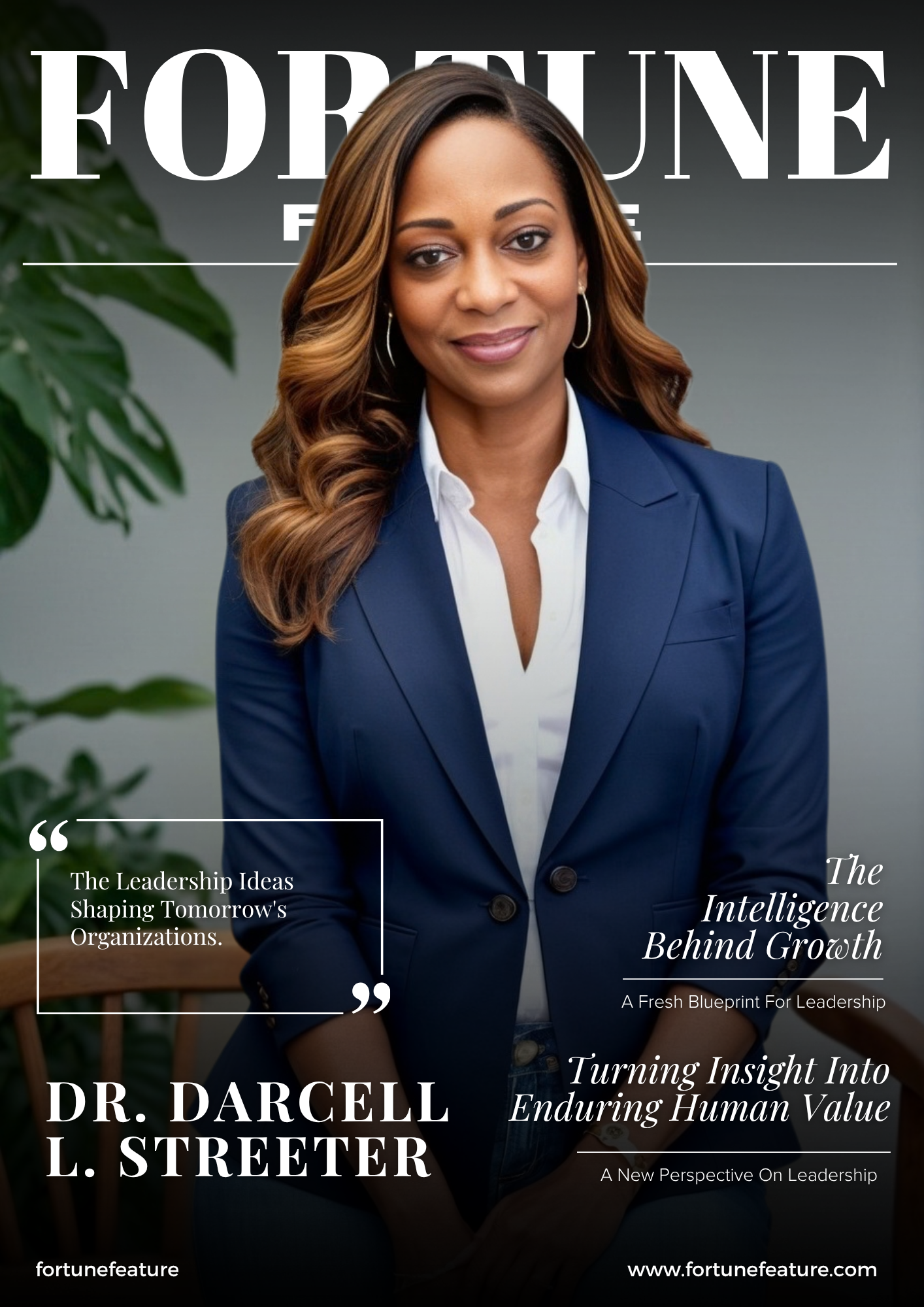
As artificial intelligence reshapes the workplace, Dr. Darcell L. Streeter is asking a more fundamental question: Are organizations developing people, or simply teaching them how to keep up?
The business world has become increasingly comfortable talking about artificial intelligence, automation, productivity and the future of work. Executives are being asked to move faster, organizations are being encouraged to become more adaptable, and employees are expected to continually acquire new skills.
But Dr. Darcell L. Streeter is interested in a question beneath all of that activity.
What happens to the human being inside the system?
It is a deceptively simple question, but one that has shaped nearly twenty five years of Streeter’s professional life. Her work brings together human development, learning sciences and leadership, with a particular interest in how institutions can create environments where people do more than perform. They actually develop.
Her perspective did not originate in a corporate boardroom or an academic conference. It began much earlier, in an emergency room.
At the beginning of her career, Streeter worked as a registration clerk in a hospital emergency department. Her responsibilities appeared straightforward. She collected information and helped people navigate the registration process.
Yet the environment gave her an unusual view of organizational design.
She watched people arrive frightened, overwhelmed and uncertain, often encountering complicated systems at precisely the moment when their ability to process information was under the greatest pressure.
The experience stayed with her.
She began to recognize that a system can be perfectly logical from the perspective of the people who built it and still fail the people expected to use it.
That observation would eventually become the foundation of her work.
The Problem Is Often Bigger Than the Person
One of Streeter’s defining ideas is that organizations too quickly place the burden of adaptation on individuals.
When someone struggles, leaders often ask what the person needs to improve. Streeter asks another question first.
What does the environment require this person to understand, and has the environment been designed to make that possible?
That distinction matters enormously in the modern workplace.
Companies are investing heavily in new technologies and new training programs, yet the success of those investments still depends on whether people can understand, absorb and apply what they are being given.
A sophisticated platform cannot compensate for a poorly designed learning experience. A new strategy cannot succeed simply because it has been communicated. And a workforce cannot become adaptable merely because leaders tell employees to adapt.
People need the conditions in which adaptation can actually occur.
This is where Streeter’s background in learning sciences becomes especially relevant to the business conversation.
She views learning not as an event, but as a process. Information has limited value if it disappears once a training session ends. The more meaningful question is whether knowledge survives long enough to influence decisions, behavior and performance.
For organizations, that can change the way leadership development is understood.
The objective is not simply to create employees who can complete a course.
It is to create people who can use what they learned when the situation changes.
The Leadership Cost of Constant Urgency
There is another element of Streeter’s philosophy that challenges conventional thinking about performance.
For years, speed has been treated as an unquestioned business advantage.
Move faster. Decide faster. Produce faster. Scale faster.
Streeter does not argue against progress. Instead, she questions what happens when urgency becomes the default operating system.
Her own experience gave her a personal understanding of that tension.
She had learned how to lead with energy and urgency, but eventually recognized that the science she was studying had implications for her own approach to work. Human beings do not learn particularly well when they are operating under continuous pressure.
That realization influenced her thinking about leadership.
A leader’s capacity is not unlimited, and organizational performance cannot be separated completely from the conditions in which people are expected to perform.
This is reflected in two of Streeter’s frameworks, Softness as a Superpower and PAWS, which translate the importance of pause and regulation into leadership practice.
The concept may sound gentle in an environment accustomed to aggressive performance language. But the underlying argument is practical.
A pause can create space for better judgment.
Reflection can improve decision making.
And creating psychological room for people can make it easier for them to learn, contribute and change.
In this sense, softness is not presented as the opposite of rigor. Streeter sees the two as capable of existing together.
The strongest organizations may ultimately be those that understand both.
Preparing for an AI Economy

Artificial intelligence makes Streeter’s work increasingly relevant because technology changes the scale at which organizational decisions operate.
When a human process is inefficient, the consequences may once have been limited to a particular department or location. When technology is introduced into that process, the same assumptions can potentially reach thousands of people.
That makes design more important, not less.
Streeter’s doctoral research examines generative AI alongside culturally responsive design. Her focus includes multilingual and multigenerational learners and communities that have historically been underserved by conventional systems.
Her concern is not whether AI should be used.
It is how it should be designed and implemented.
Who does the system assume is using it?
What does it consider a capable learner?
What happens when the person interacting with the technology does not fit those assumptions?
These questions move the conversation beyond technology adoption and into organizational responsibility.
The next generation of business leaders will not simply have to understand what AI can do. They will have to understand what happens when AI becomes part of the systems through which people learn, work and make decisions.
That requires a different kind of leadership.
From Credentials to Capability
Streeter’s approach also challenges the way professional success is traditionally measured.
She has accumulated recognition, publications and professional milestones, but she is cautious about treating visibility as proof of impact.
For her, the more meaningful measure is what remains after the formal interaction is over.
Did the learner become more capable?
Did the organization become more resilient?
Did the knowledge transfer into a completely different situation?
Did someone develop enough confidence and understanding to continue without constant supervision?
These are harder questions than counting attendance, certificates or immediate performance results.
They are also closer to the realities of long term development.
In business, this distinction can be significant.
Companies can spend heavily on training and still fail to build genuine capability. They can fill calendars with workshops while leaving the underlying culture unchanged.
Streeter’s philosophy suggests that organizations should pay greater attention to whether learning becomes part of how people actually work.
That is where development becomes human capital rather than simply an expense line.
A Different Kind of Future Workforce
Streeter’s vision extends beyond individual leadership development.
Her upcoming initiative, Circle Forward, is designed as a Global Life and Learning Hub that connects K through 12 STEAM education with adult vocational development.
The concept challenges the traditional separation between generations.
Children learn in one system. Adults enter another. Professional development becomes something people pursue later, often after formal education has ended.
Circle Forward imagines a more connected model.
Knowledge can move between generations instead of traveling in only one direction.
A young learner may bring technological knowledge into the relationship, while an older participant may bring professional experience, practical knowledge and a deeper understanding of how industries operate.
The model is intended to be replicable, with regional hubs planned for West Africa, Latin America and Southeast Asia.
It also reflects another important part of Streeter’s thinking about the future of work.
Economic opportunity should not always require geographic displacement.
Her vocational pathways are designed with automation in mind and aim to help women access global economic opportunities while remaining connected to their own communities.
It is an ambitious idea, but its underlying principle is straightforward.
The future of work should expand human possibility rather than simply reorganize human labor.
Building Organizations Around People

There is a consistent thread running through Streeter’s work.
She does not begin with technology.
She begins with people.
That distinction may become increasingly important as businesses navigate an era in which technology can change faster than organizational culture can absorb it.
Companies will continue adopting AI. Jobs will evolve. Skills will become obsolete and new ones will emerge. Learning will increasingly happen through digital platforms and intelligent systems.
But none of those developments remove the fundamental realities of human development.
People need context.
They need meaningful opportunities to practice.
They need environments where questions are possible.
They need enough psychological space to absorb change.
And they need leaders who understand that development cannot be reduced to a productivity metric.
Dr. Darcell L. Streeter’s work sits at precisely that intersection.
Her contribution is not simply another argument for better leadership or more thoughtful learning. It is a broader invitation to rethink how organizations are designed in the first place.
The most important business systems of the future may not be the ones that move the fastest.
They may be the ones that understand people well enough to help them move forward.
For Streeter, that means building organizations where technology serves human development rather than replacing it, where learning is measured by what lasts rather than what is completed, and where leadership leaves enough room for people to become more capable than they were before.
As businesses enter a period of extraordinary technological change, that perspective offers a useful reminder.
Innovation may determine what an organization can build.
But people determine what that organization can become.